
Retailers claim online firms' predatory pricing strategy disrupting business

Union Finance Minister Nirmala Sitharaman on Monday said people are finding current interest rates "very stressful" and urged banks to make them affordable. Speaking at an event organised by State Bank of India, the finance minister said that at present, India requires industry to ramp up and invest in new facilities, and added that lowering lending rates can help achieve the "Viksit Bharat" aspiration.

The final policy may be out only after formation of the new government, according to sources

Reliance Industries Ltd has consolidated its balance sheet after the previous round of capex and is ready for the next level of growth, its chairman and managing director Mukesh Ambani said outlining plans from net zero to roll-out of True5G telecom network and retail. In the firm's latest annual report, he said in the world of volatility and uncertainty, India is shining as a beacon of stability and prosperity.

The draft favoured up to 49 per cent foreign equity in inventory model in the case of 100 per cent made in India products sold through Indian management-controlled platforms with resident Indian founders/promoters.

Marico may buck the industry trend with the fast-moving consumer goods (FMCG) major reporting strong growth and favourable commentary in a weak quarter for the industry. The company reported consolidated revenue growth of 8 per cent year-on-year (Y-o-Y) in Q2FY25. Domestic revenue growth was 8 per cent Y-o-Y with 5 per cent volume growth (4 per cent in Q1FY25).

Three years and Rs 28,710 crore worth of transactions later, it has more than double the number of sellers than Flipkart.

What stood out in his 15-year journey as a member of the political executive at the Centre was his glowing record as India's most successful and effective finance minister. Both as prime minister and finance minister, he understood the importance of gradualism, except when the economy or the polity was in a crisis.

'The critical event signalling a new era for India was Dr Singh's 1991 Budget in which he quoted Victor Hugo to say that no power on earth could stop an idea whose time has come,' recalls T N Ninan.

Union Home Minister Amit Shah asserted that the abrogation of Article 370 in 2019 was crucial in ending terrorism in Kashmir. He stated that the provision fostered separatism among Kashmiri youth and impeded the region's full integration into India. Shah also highlighted the development initiatives undertaken in Jammu and Kashmir post-Article 370, including a reduction in terrorism, successful local body elections, and an increase in tourism and film production. He emphasized the significance of writing India's history with facts and evidence, countering narratives that had obscured the country's rich heritage.

Sources within the Congress, including those who have been members of the teams that drafted its 2019 and 2024 Lok Sabha poll manifestos, said the Karnataka government decision lacked any empirical basis.

A senior official of India Post at Kolkata General Post Office told PTI that since e-commerce is a sunrise industry, it is trying to earn higher revenue in the region by involving local traders and business houses.

Govt's e-commerce portal asks sellers to specify country origin of products. Now, the commerce & industry ministry has mandated that the Government e-Marketplace, which has seen Rs 55,048 crore worth of transactions till now, adopt this approach in the interest of creating an 'Aatmanirbhar Bharat'.

Tata Communications on Wednesday announced that it would acquire NYSE-listed Kaleyra, a global omnichannel integrated communication services provider with a set of proprietary platforms offering targeted personalisation through messaging, video, push notification, e-mails and voice-based services, and chatbots. The acquisition is an all cash deal. Tata Communications has agreed to acquire Kaleyra at a price per share of $7.25, for a total consideration to Kaleyra shareholders of approximately $100 million, besides the assumption of all outstanding debt.

India stares at the risk of an influx of Chinese products as US tariffs on a range of Chinese goods, including solar panels, electric vehicles, lithium-ion batteries, syringes, and steel, are set to take effect from September 27. With higher tariffs reducing China's access to the US market, there is concern that China may divert its exports to other markets, including India, which could lead to potential dumping of goods. This situation could challenge Indian industries, particularly in sectors where competition with Chinese products is already fierce.

The production of eight infrastructure sectors rose by 7.5 per cent in October on healthy performance by the segments of coal, natural gas, refinery products and cement, official data released on Tuesday showed. The output of eight core sectors of coal, crude oil, natural gas, refinery products, fertilisers, steel, cement and electricity had contracted by 0.5 per cent in October 2020, according to the data released by the commerce and industry ministry. Core sectors' growth stood at 4.5 per cent in September this year.

'One of the aspects for transparency and fair governance is to give the industry being represented the chance of lobbying with the regulator.'

Make no mistake, Reliance's entry into Indian e-commerce cannot be taken lightly. It is akin to a combine of AT&T and Wal-Mart challenging Amazon on its home turf, says Shailesh Dobhal.

Concerned over the fallout of the Red Sea crisis and severe shortage of containers against the backdrop of a steep decline in merchandise exports in August, the Union government is pulling out all the stops to find a solution. To begin with, the government has devised a strategy aimed at boosting container supply and supporting exporters.

The revamped Special Economic Zone (SEZ) law is unlikely to see the light of the day before the upcoming Lok Sabha elections, two people aware of the matter said. The commerce department had sought the Union Cabinet's nod to bring amendments to the existing SEZ Act, 2005 late last year. The plan, thereafter, was to introduce the Bill in the winter session of Parliament. Cabinet's approval remains pending.
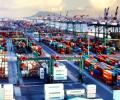
100-day agenda: Commerce ministry pushes for separate logistics department

Ajit Balakrishnan offers a thinking man's guide to e-commerce controversies.

The two countries also signed a 'Memorandum of Agreement regarding the Assignment of Liaison Officers', which will facilitate the posting of one military officer from each country with the military of the other.

Tata Group's CLiQ is the latest to join the e-commerce club, to compete with the likes of Amazon, Flipkart and Snapdeal.

Walmart group firm Flipkart continues to dominate the e-commerce segment with 48 per cent market share while Softbank-backed Meesho has emerged as the fastest growing e-commerce platform in terms of user base in India, a latest report by AllianceBernstein said. According to the report, Flipkart's user base grew 21 per cent year-on-year (YoY), Meesho accelerated at 32 per cent while Amazon lagged at 13 per cent user growth primarily due to relative premium offerings as compared to peers. "As of FY23, Flipkart was the market leader, with a 48 per cent share in India eCommerce.

India Inc on Thursday pitched for lowering income tax burden on common man, increase in capital expenditure, and firm steps to contain food inflation in their nearly two-hour long interaction with finance minister Nirmala Shitharaman ahead of the Union Budget. During pre-Budget consultation with Sitharaman, the industry leaders and associations also urged the government to focus more on infrastructure development with a view to maintaining the economic growth momentum. The industry leaders also laid stress on boosting the MSME (micro, small, and medium enterprises) sector, considered a backbone of the Indian economy and main employment generator.

Wholesale inflation in the country rose for the fourth consecutive month in June at 3.36 per cent on account of rise in prices of food articles, especially vegetables and manufactured items. The wholesale price index (WPI) based inflation was 2.61 per cent in May. It was (-) 4.18 per cent in June 2023.

State-run Life Insurance Corporation of India (LIC) has committed Rs 600 crore for its digital transformation journey, Sunder Krishnan, chief risk officer said on Wednesday. The insurance giant is also aiming to become completely "paperless" in two years. "We have hired a large system integrator for more than Rs 400 crore, a consultant for digital transformation for Rs 100 crore, and Rs 100 crore for agency transformation.

Amidst strained ties with China, the pre-budget Economic Survey on Monday made a strong case for seeking foreign direct investments (FDI) from Beijing to boost local manufacturing and tap the export market. As the US and Europe are shifting their immediate sourcing away from China, it is more effective to have Chinese companies invest in India and then export the products to these markets rather than importing from the neighbouring country, the Survey said.

These 10 stocks represent the best mix of value and growth, offering relatively low price-to-earnings and price-to-book ratios, a high return on equity, and sufficiently high potential from current levels.

With more than 10,000 stores under the various Reliance retail brands and over 2.5 million kirana stores already tying up with it, Jio's online marketplace would have the biggest hyperlocal logistics network in the country.

Out of all the reported digital payment frauds in India, over half (55 per cent) were United Payments Interface (UPI)-related, a new report released on Tuesday revealed. Another 18 per cent are card related, 12 per cent are related to internet banking and nine per cent are from phishing calls. Most of the UPI-related frauds, however, have a low ticket size.
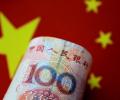
India is not "rethinking" supporting investments from China, said Commerce and Industry Minister Piyush Goyal on Tuesday, referring to a proposal made in the Economic Survey 2024. The survey by India's chief economic advisor last week said India had two "choices" to benefit from the so-called China plus one strategy, either by integrating into that country's supply chain or by promoting foreign direct investment (FDI). "Chief economic advisor's report speaks about new ideas and gives out their own thinking. It is not at all binding on the government and there is no rethinking to support Chinese investments in the country," Goyal told reporters in Delhi.

The government on Friday scrapped a minimum price threshold that it had set previously for exports of onion as it looked to pass on the benefit of international glut to Indian farmers. The government had previously fixed a $550 per tonne as the minimum export price (MEP), which essentially meant farmers could not sell their produce overseas at lower than this rate.

India has reduced the time period for foreign investors to seek international arbitration from five years to three years as part of the recently signed investment pact with the United Arab Emirates (UAE), a departure from its model Bilateral Investment Treaty (BIT). Under the Investor-State Dispute Settlement (ISDS) mechanism, if the Indian judicial system is unable to resolve a dispute within this shortened period, investors can resort to international arbitration. The investment pact, signed on February 13 in Abu Dhabi, came into force on August 31, replacing the previous pact.
.jpg)
The indicative salary outlook for junior employees is Rs 1.45 lakh-Rs 3 lakh per annum, while for mid-management it is between Rs 12 lakh-Rs 30 lakh per annum

The MHA on Friday, while extending the lockdown for two more weeks till May 17, lifted many restrictions in green and orange zones. There are no restrictions on sale of non-essential items by e-commerce platforms in green and orange zones, a home ministry spokesperson said, adding barber shops and salons are also allowed to open in these areas.

'The overwhelming evidence from various studies and reports indicates that the current work culture in the IT sector, characterised by excessive hours, has severe consequences for health, productivity, and overall quality of life.'

The output of eight core infrastructure sectors grew marginally by 0.1 per cent in January, mainly due to growth in the production of fertiliser, steel and electricity. The core sectors had expanded by 2.2 per cent in January 2020, according to the provisional data released by the commerce and industry ministry on Friday. Coal, crude oil, natural gas, refinery products, and cement recorded negative growth in January.

E-retailers with foreign investments may now find it difficult to provide discounts.
